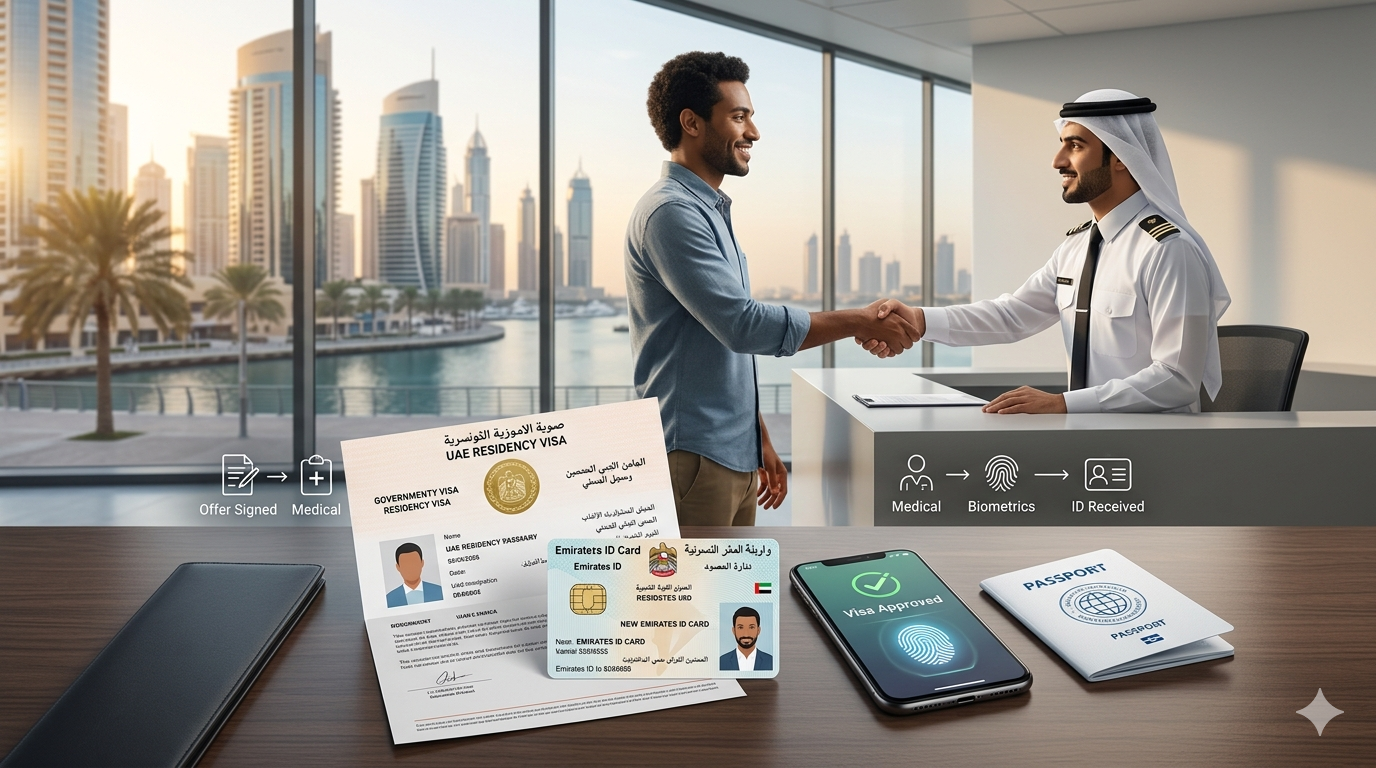
So, you’ve landed a job in the City of Gold? Congratulations! Dubai isn’t just a skyline of glittering skyscrapers; it’s a land of immense professional opportunity. But before you can start enjoying those weekend brunches or desert safaris, there is one major hurdle to clear: the paperwork.
Navigating the work visa process Dubai step by step can feel like a maze if you don’t have a map. Between labor contracts, medical screenings, and biometric appointments, it’s easy to get overwhelmed.
In this guide, I’m going to walk you through the entire journey—from the moment you sign your offer letter to the day you hold your Emirates ID. No fluff, no confusing legal jargon, just a clear, human-friendly roadmap to getting your life started in the UAE.
Understanding the Landscape: Who Issues Your Visa?
Before we dive into the steps, it is important to understand that your employer is the “sponsor.” In the UAE, you cannot simply apply for a work visa on your own; a licensed company must initiate the process for you.
The Two Main Jurisdictions
Depending on where your company is located, the rules might vary slightly:
- Mainland Companies: Regulated by the Ministry of Human Resources and Emiratisation (MOHRE).
- Free Zones: (Like DMCC, DIFC, or JAFZA) These have their own internal authorities and slightly different sets of rules.
Regardless of the jurisdiction, the core work visa process Dubai step by step remains largely the same.
Step 1: The Job Offer and Labor Contract
The process officially begins when you accept a job. However, a simple email saying “I accept” isn’t enough for the UAE government.
- The Offer Letter: Your employer will issue a formal offer letter that aligns with MOHRE standards.
- The Signature: You must sign this letter. If you are outside the country, this can often be done digitally.
- Key Tip: Ensure your job title on the contract matches your actual qualifications. Sometimes, specific titles require attested degrees (which we will discuss later).
Important Note: Under UAE law, it is illegal for an employer to charge you for your visa processing fees. All costs related to your recruitment and residency should be covered by the company.
Step 2: Documents You Need to Prepare
Preparation is the secret to a stress-free visa application. You don’t want to be scrambling for a birth certificate or a degree at the last minute.
Required Documents for [UAE employment visa requirements]:
- Passport: Must be valid for at least 6 months.
- Passport-sized Photos: White background (you’ll need several of these).
- Attested Educational Certificates: If you have a degree, it must be legalized by the Ministry of Foreign Affairs in your home country and then by the UAE Embassy.
- Previous Visa Cancellation: If you were previously working in the UAE, you need the cancellation paper from your old boss.
Step 3: Getting Your Entry Permit
Once your paperwork is in order, your employer will apply for your Entry Permit. Think of this as a “temporary door pass.”
- Processing Time: Usually 2 to 7 working days.
- The “In-Country” Change of Status: If you are already in Dubai on a tourist visa, you don’t necessarily have to fly out. Your employer can pay a fee for a “Change of Status” to move you from a tourist category to an employment category while you stay on the sofa at home.
Step 4: The Medical Fitness Test
This is perhaps the most critical part of the work visa process Dubai step by step. To maintain public health standards, the UAE requires all residents to pass a medical screening.
What happens during the test?
- Blood Test: Specifically checking for communicable diseases like HIV and Hepatitis B (for certain professions).
- Chest X-Ray: To check for Tuberculosis (TB).
Where to go? You will visit an authorized Medical Fitness Center (like those run by DHA or MOHRE).
- Pro Tip: Wear comfortable clothes and try to go early in the morning to avoid long queues. Results usually take 24–48 hours, but “VIP” services can get them to you in 4 hours.
Step 5: Biometrics and the Emirates ID
Once you pass your medical, it’s time to get “into the system.” You will need to visit an ICA (Federal Authority for Identity, Citizenship, Customs & Port Security) center.
- Fingerprinting: They will take your digital fingerprints.
- Eye Scan: A quick scan for security records.
- The Benefit: Your Emirates ID is your lifeblood in Dubai. You’ll need it to rent an apartment, open a bank account, and even get a SIM card.
Step 6: Health Insurance Mandatory Coverage
You cannot get your visa stamped without proof of health insurance. In Dubai, it is a legal requirement for your employer to provide you with at least the Essential Benefits Plan (EBP).
While the company must cover you, you are usually responsible for arranging coverage for your dependents (spouse or children) if you bring them over later.
Step 7: Visa Stamping (The Residency Sticker)
The final “official” step is the visa stamping. Your passport used to receive a physical sticker, but in 2026, the UAE has largely moved toward digital residency.
Your residency status is now linked directly to your Emirates ID. Once the immigration department approves your file, you are officially a Dubai resident! You can now travel in and out of the country using your passport and ID.
Navigating [Dubai work permit costs and fees]
While the employer pays the bulk of the fees, it helps to know what the costs look like for 2026.
| Item | Estimated Cost (AED) | Paid By |
| Entry Permit | 500 – 1,000 | Employer |
| Change of Status | 600 – 1,100 | Employer |
| Medical Test | 300 – 800 | Employer |
| Emirates ID (2 years) | 270 – 370 | Employer |
| Labor Card | 300 – 5,000+ | Employer |
Note: Costs vary based on the company’s category and whether they are in a Free Zone.
Common Challenges: [Dubai work visa processing time 2026]
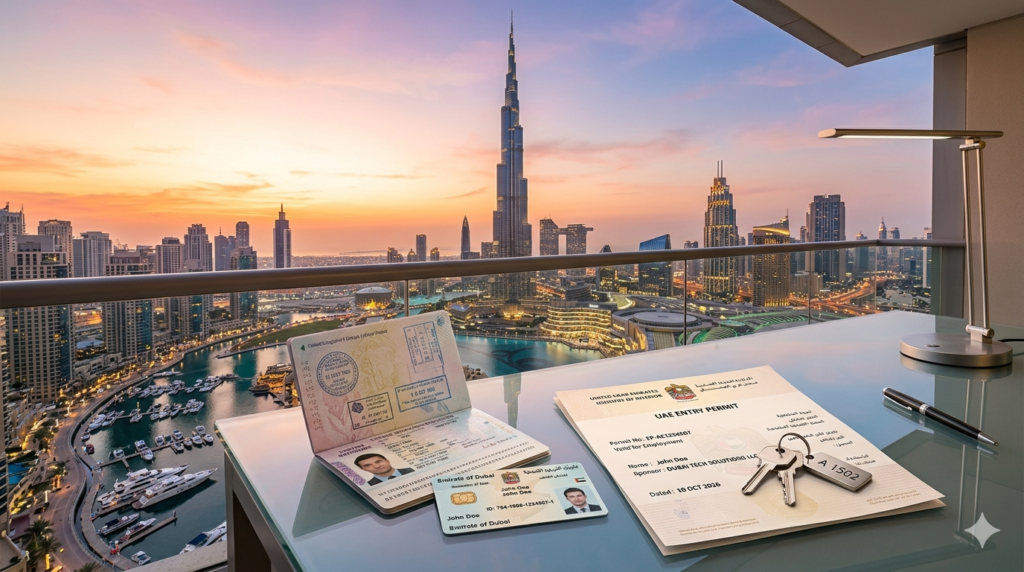
Patience is a virtue when dealing with government bureaucracies. On average, the entire work visa process Dubai step by step takes about 3 to 4 weeks.
What can delay your visa?
- Public Holidays: Eid breaks can pause government offices for several days.
- Incomplete Documentation: A missing attestation on a degree is the #1 cause of delays.
- Security Clearance: Occasionally, additional background checks are required, which can add a week or two to the timeline.
Expert Tips for a Smooth Relocation
- Digital Copies are King: Keep a folder on Google Drive or Dropbox with high-quality scans of your passport, photos, and attested degrees. You will be asked for them repeatedly.
- Stay Legal: Never work for a company while you are on a tourist visa without the “Entry Permit” being issued. This can lead to heavy fines and deportation.
- Check Your Profession: Some professions (like doctors, engineers, or teachers) require additional “equivalency” certificates from the Ministry of Education.
FAQ: Your Questions Answered
1. Can I stay in Dubai while my work visa is being processed?
Yes. If you enter on a tourist visa or are already in the country, your employer can apply for a “Change of Status.” You don’t have to leave the UAE, though a fee applies.
2. What happens if I fail the medical test?
If a person tests positive for HIV or active TB, the visa is typically denied, and the individual may be deported. However, for TB, there are often options for treatment if it is considered “old” or “scarred,” depending on the latest health regulations.
3. How long is the Dubai work visa valid?
Typically, work visas are issued for 2 years for mainland companies and sometimes 3 years for Free Zone companies. These are renewable as long as you remain employed.
4. Can I bring my family while my visa is in progress?
It is better to wait until your Emirates ID is in hand. Once your residency is finalized, you can then sponsor your spouse and children under your name.
5. Can I work for two companies at once?
Generally, no. You are tied to your primary sponsor. However, you can get a “Part-time Work Permit” from MOHRE if your primary employer gives you written permission (NOC).
Final Thoughts
The work visa process Dubai step by step might seem like a lot of hoops to jump through, but it’s a very organized system. Once you get through the medical and biometrics, the rest is just waiting for the mailman to deliver your Emirates ID.
Dubai is a city built on the dreams and hard work of expats. By following the rules and staying organized, you’re setting yourself up for a successful and stress-free start to your new chapter in the UAE.
Would you like me to create a checklist of the specific documents you need based on your home country?
Internal & External Reference Ideas:
- Internal Linking: Use anchor text like “How to find a job in Dubai,” “Renting your first apartment in Dubai,” or “Cost of living in UAE 2026.”
- External Reference Topics: Link to the official [U.ae (UAE Government Portal)] for visa fee updates or the [DHA (Dubai Health Authority)] for medical center locations.